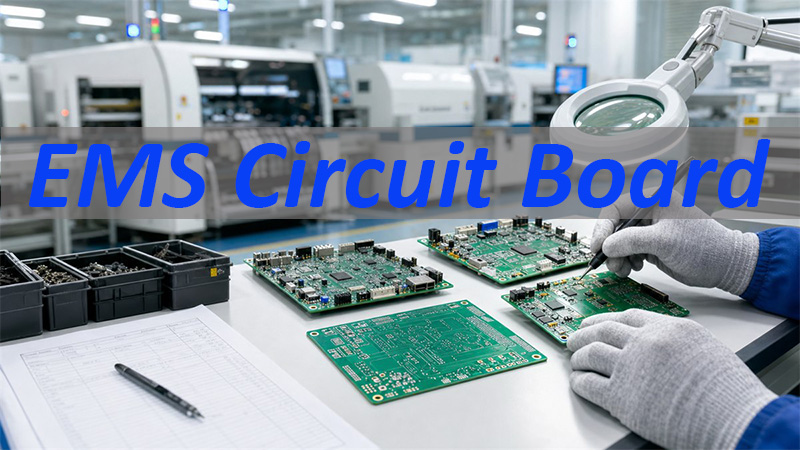
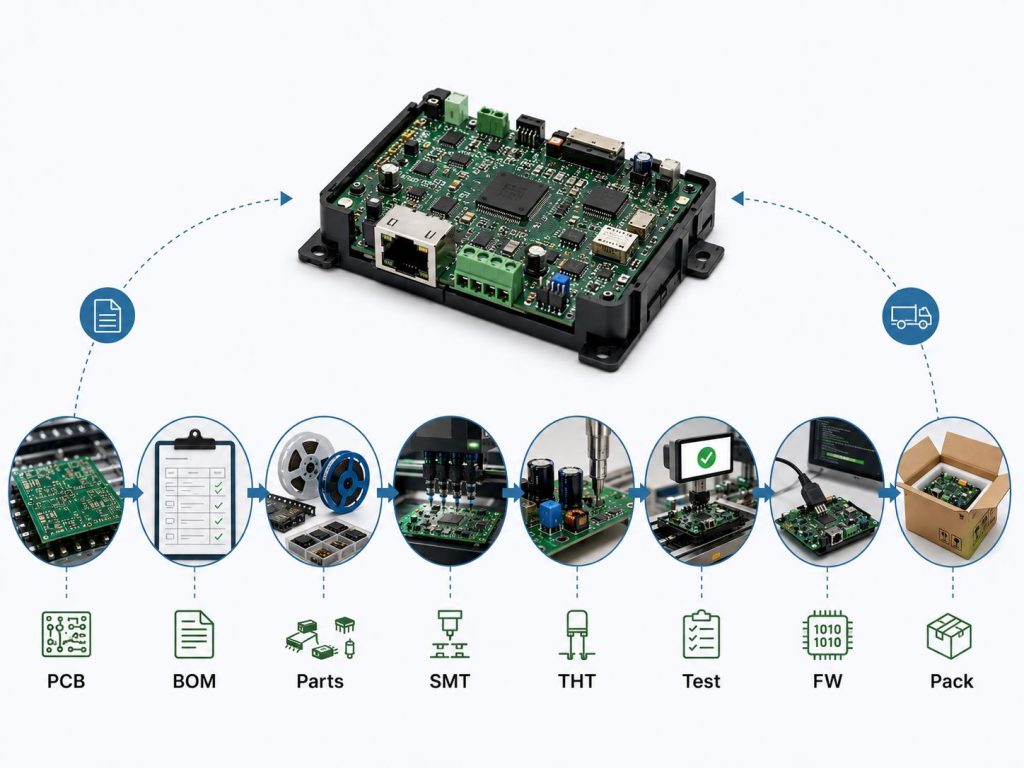
An EMS circuit board project usually means more than buying a bare PCB. In electronics manufacturing services, the circuit board may need PCB fabrication, component sourcing, SMT assembly, through-hole assembly, inspection, testing, packing, and delivery under one coordinated workflow.
For OEM engineers, this matters because many circuit board problems do not appear in only one step. A PCB stackup issue may affect impedance. A BOM issue may delay SMT. A connector note may affect assembly strength. A packing requirement may affect final delivery. EBest Circuit (Best Technology) supports custom PCB fabrication, BOM review, component sourcing, PCBA assembly, inspection, testing coordination, and small-batch to production support. If you are preparing an EMS PCBA project, please send your Gerber files, BOM, drawings, assembly notes, or testing requirements to sales@bestpcbs.com for engineering review before production.
What Is an EMS Circuit Board in Electronics Manufacturing?
An EMS circuit board refers to a PCB or PCBA project handled through an Electronics Manufacturing Services workflow. In this context, EMS does not mean a replacement control board, RV board, or muscle stimulation device board. It means a manufacturing service model where one supplier helps manage the production path from circuit board files to assembled electronics.
An EMS circuit board project may include:
- Bare PCB fabrication
- Component sourcing
- BOM review
- SMT assembly
- Through-hole assembly
- Connector assembly
- Cleaning and inspection
- Functional test support
- Firmware loading if files and instructions are provided
- Packing and delivery
For simple bare boards, standard PCB fabrication may be enough. For products that need assembly, components, testing, documentation, and repeat delivery, an EMS model is usually more practical.
EMS Circuit Board vs PCB Assembly and PCBA
The terms EMS circuit board, PCB assembly, and PCBA are related, but they are not exactly the same.
| Term | Meaning |
|---|---|
| PCB | Bare printed circuit board |
| PCB assembly | Components mounted on the PCB |
| PCBA | Finished printed circuit board assembly |
| EMS circuit board | PCB or PCBA handled through an EMS workflow |
PCB assembly mainly describes the mounting process. EMS circuit board manufacturing describes the broader production support around the board.
That broader support may include:
- Checking whether PCB files match assembly needs
- Reviewing BOM availability before production
- Confirming surface finish and soldering process
- Planning SMT, through-hole, or mixed assembly
- Preparing inspection and testing steps
- Managing packaging and shipping notes
This is why an EMS circuit board supplier should understand both PCB fabrication and assembly. If the bare board and PCBA are handled separately, small details can be missed between suppliers.
When Do OEM Customers Need EMS Circuit Board Manufacturing?
OEM customers usually need EMS circuit board manufacturing when the project has more than one production risk.
Typical situations include:
- The product needs PCB fabrication and SMT assembly together
- The BOM has supply risk or approved alternatives
- The board uses BGA, QFN, fine-pitch ICs, or dense connectors
- The project needs prototype validation before small-batch production
- The customer needs test reports, impedance reports, or inspection records
- The product needs individual packing, labels, or special delivery notes
- The assembly includes both SMT and through-hole components
- The project will later move from sample build to repeat production
For engineers, the value of EMS support is not only convenience. It is risk control. One team keeps the PCB files, BOM, assembly notes, testing needs, and delivery requirements visible throughout the project.
EMS Circuit Board Manufacturing Process from PCB to PCBA
A practical EMS circuit board process should connect the board and assembly steps clearly.
At EBest Circuit, a typical PCB and PCBA workflow may include:
| Stage | Main Check |
|---|---|
| File review | Gerber, stackup, drawing, notes |
| BOM review | Part numbers, alternates, risk items |
| PCB fabrication | Material, copper, finish, testing |
| SMT preparation | Panel, stencil, placement data |
| SMT assembly | Printing, placement, reflow |
| Inspection | SPI, AOI, X-Ray when needed |
| Through-hole | Manual or selective soldering |
| Testing | Electrical or functional support |
| Packing | ESD, labels, unit packing |
This process helps avoid a common problem: the PCB is made correctly as a bare board, but the assembly team later finds missing notes, unsuitable panel design, unclear polarity marks, or hard-to-source components.
For EMS circuit board projects, manufacturing review should happen before production starts, not after SMT problems appear.
BOM Sourcing and Component Control for EMS Circuit Board Projects
BOM control is one of the most important parts of EMS circuit board manufacturing. A board cannot be assembled correctly if the component data is incomplete or unstable.
A useful BOM should include:
- Manufacturer part number
- Designator
- Quantity
- Package
- Value
- Tolerance
- Voltage or power rating
- Approved substitutes if allowed
- Customer-supplied or supplier-sourced note
EBest Circuit can help review the BOM and provide a BOM optimization list when needed. This is useful when parts are obsolete, long-lead, high-risk, or not suitable for the assembly process.
For EMS projects, BOM review is not only a purchasing task. It affects:
- Lead time
- Assembly yield
- Cost control
- Replacement approval
- Testing stability
- Future repeat orders
If a customer supplies all materials, the incoming material process still matters. If EBest Circuit sources components, the team can coordinate PCB fabrication and SMT preparation based on material readiness.
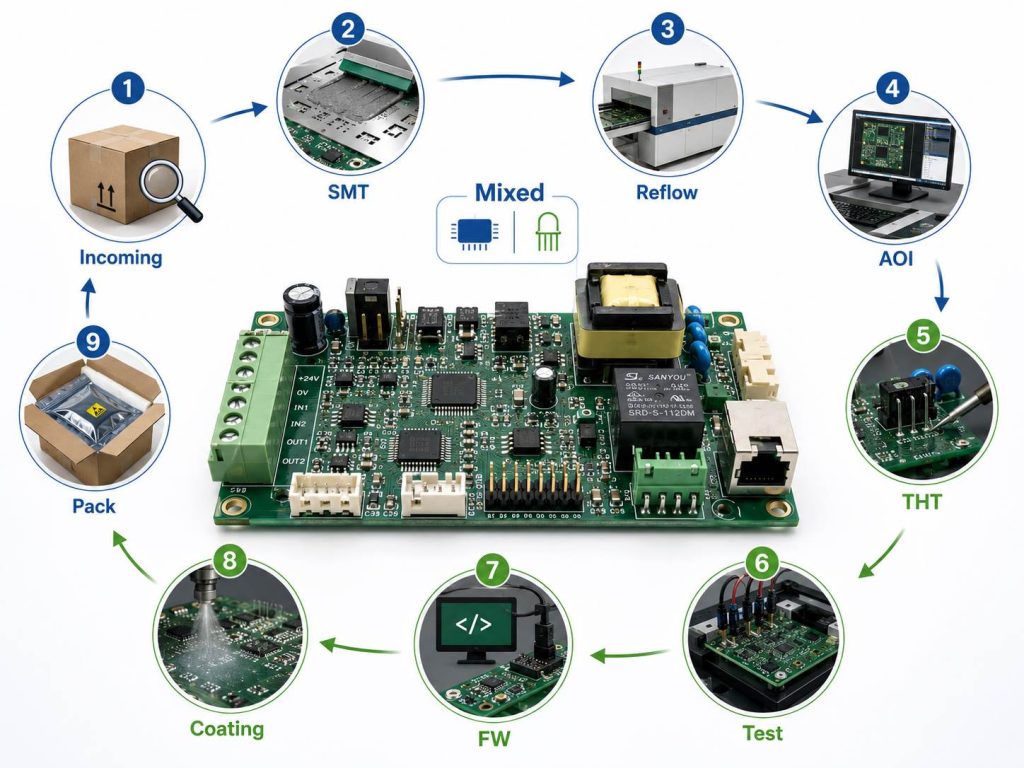
SMT, Through-Hole, and Mixed Assembly for EMS Circuit Boards
Many EMS circuit board projects are not pure SMT. Some include connectors, switches, terminals, headers, transformers, relays, or other through-hole parts.
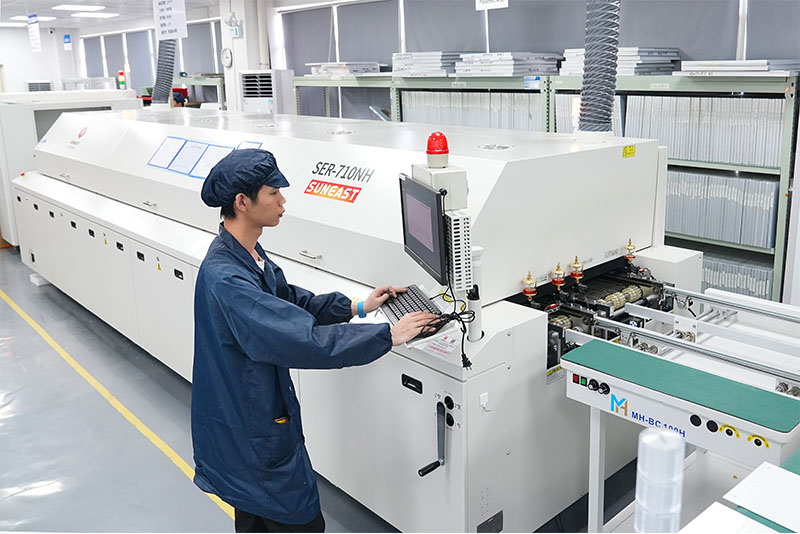
A typical SMT process may include:
- Incoming PCB and component check
- Baking when required
- Solder paste printing
- SPI inspection
- Pick and place
- Reflow soldering
- Post-reflow inspection
- AOI
- X-Ray for BGA or hidden joints when needed
- Cleaning if required
- Programming or testing if files are provided
- Conformal coating or potting if specified
- Labeling, separation, and packing
Mixed assembly needs extra attention because mechanical parts often create real-use stress. A connector may pass electrical testing but fail later if solder joints or board support are weak. A terminal block may need enough copper width, solder volume, and mechanical clearance. A relay or power component may need heat and current review.
For EMS circuit board production, the assembly notes should clearly state:
- Polarity direction
- Connector orientation
- Customer-supplied parts
- Cleaning requirements
- Test method
- Packing method
- Labeling rules
- Special handling requirements
Clear notes reduce unnecessary back-and-forth before production.
Quality Checks for EMS Circuit Board Production
Quality control for EMS circuit board projects should cover both the bare PCB and the assembled PCBA.
Bare PCB checks may include:
- Material and thickness review
- Copper thickness confirmation
- Solder mask inspection
- Surface finish inspection
- Electrical test
- Impedance control when required
- Visual inspection against IPC requirements
Assembly checks may include:
- First article inspection
- Solder paste inspection
- AOI after reflow
- X-Ray for BGA or hidden solder joints
- Polarity and component placement check
- Connector and through-hole solder inspection
- Cleaning check
- Functional test coordination when required
EBest Circuit also supports traceability through production tracking. For projects that need stable repeat orders, traceability helps connect materials, production process, inspection records, and delivery status.
The goal is simple: defects should be found at the right checkpoint, before they become more expensive to fix.
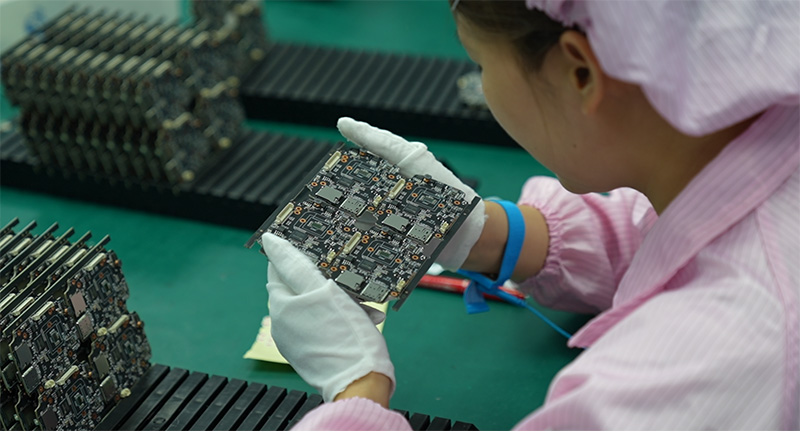
EMS Circuit Board Case Study for Small-Batch PCBA Delivery
A European industrial electronics customer needed a small-batch EMS circuit board build for product validation. The project was not only a bare PCB order. It required PCB fabrication, component sourcing, SMT assembly, inspection, and single-unit delivery after assembly.
Project focus:
- FR4 PCB fabrication
- SMT assembly
- Supplier-managed component sourcing
- Clean board surface after assembly
- Individual unit delivery
- Production files confirmed before build
Main risks:
- BOM lead time could delay SMT
- Incorrect panel planning could affect assembly efficiency
- Connector and component placement needed stable inspection
- The customer needed finished boards ready for validation, not only bare PCBs
EBest Circuit’s support:
- Reviewed Gerber, BOM, placement file, and assembly notes
- Checked component sourcing risk before SMT
- Coordinated PCB fabrication and assembly schedule together
- Used inspection steps after SMT to reduce visible solder and placement defects
- Packed the assembled boards according to delivery requirements
For the customer, the value was not just receiving assembled boards. The value was having one team manage the details between PCB, BOM, SMT, inspection, and delivery. That reduced the chance of delays and helped the customer move the project into validation faster.
Why Choose EBest Circuit for EMS Circuit Board Manufacturing?
EBest Circuit is suitable for EMS circuit board projects where the customer needs more than bare PCB fabrication.
What we support:
- PCB fabrication
- Component sourcing
- BOM review
- SMT assembly
- Through-hole assembly
- PCBA testing coordination
- Prototype and small-batch support
- Production communication and delivery follow-up
PCB types we support:
- FR4 PCB
- Multilayer PCB
- HDI PCB
- Flexible PCB
- Rigid-flex PCB
- Metal core PCB
- Ceramic PCB
- High Tg PCB
- Heavy copper PCB
- Impedance-controlled PCB
Engineering and quality support:
- DFM review before production
- BOM optimization support
- 20-year PCB and PCBA engineering experience
- ISO9001, ISO13485, IATF16949, AS9100D
- RoHS and REACH awareness
- Digital production traceability
- Prototype to production support
EBest Circuit has more than 20 years of PCBA experience and supports engineers who need PCB manufacturing, sourcing, assembly, testing, and delivery under one workflow. For custom EMS circuit board projects, this helps keep technical notes visible from file review to final shipment.
FAQs about EMS Circuit Board Manufacturing
1. What does EMS circuit board mean?
An EMS circuit board is a PCB or PCBA project handled through Electronics Manufacturing Services. It may include PCB fabrication, component sourcing, assembly, testing, and delivery support.
2. Is EMS circuit board the same as PCBA?
Not exactly. PCBA means the assembled circuit board. EMS circuit board manufacturing covers the wider production workflow around the board, including sourcing, assembly, inspection, testing, and logistics.
3. What files are needed for an EMS circuit board quote?
Useful files include Gerber or ODB++ data, BOM, pick-and-place file, assembly drawing, PCB drawing, test requirements, special process notes, and packing requirements.
4. Can EBest Circuit source components for EMS circuit board projects?
Yes. EBest Circuit can support component sourcing based on the approved BOM. If substitutes are needed, customer approval should be confirmed before production.
5. Does EBest Circuit support prototype and small-batch EMS circuit board production?
Yes. EBest Circuit supports prototype, small-batch, and production projects, including PCB fabrication, PCBA assembly, testing coordination, and delivery support.
If your EMS circuit board project needs PCB fabrication, BOM sourcing, SMT assembly, inspection, testing, or small-batch production support, please contact sales@bestpcbs.com. Send us your files and project notes, and our engineering team will help review the manufacturing path before production starts.
Tags: ems circuit board, EMS Circuit Boards, EMS PCBA
PakarPBN
A Private Blog Network (PBN) is a collection of websites that are controlled by a single individual or organization and used primarily to build backlinks to a “money site” in order to influence its ranking in search engines such as Google. The core idea behind a PBN is based on the importance of backlinks in Google’s ranking algorithm. Since Google views backlinks as signals of authority and trust, some website owners attempt to artificially create these signals through a controlled network of sites.
In a typical PBN setup, the owner acquires expired or aged domains that already have existing authority, backlinks, and history. These domains are rebuilt with new content and hosted separately, often using different IP addresses, hosting providers, themes, and ownership details to make them appear unrelated. Within the content published on these sites, links are strategically placed that point to the main website the owner wants to rank higher. By doing this, the owner attempts to pass link equity (also known as “link juice”) from the PBN sites to the target website.
The purpose of a PBN is to give the impression that the target website is naturally earning links from multiple independent sources. If done effectively, this can temporarily improve keyword rankings, increase organic visibility, and drive more traffic from search results.